
When property developer Folkhem made a policy decision in 2012 to build exclusively in timber, the industry had barely begun discussing climate impact. Fourteen years later, the company is one of the actors pushing knowledge development hardest, in close collaboration with the research community. But one question remains unresolved.
The decision was rooted in climate benefit. In 2012, the technology for timber construction was mature, supply chains were in place, and the figures on concrete and steel's climate footprint were available for those who looked. The only thing missing was the will to take the step.
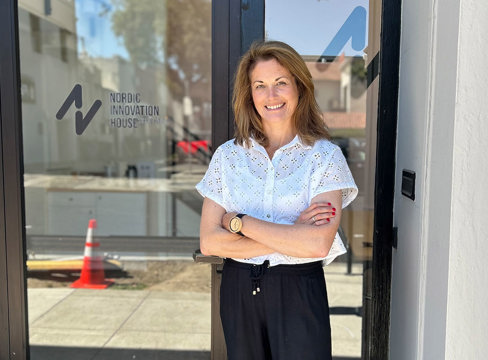
“The main motive was about the climate aspect. Not many were talking about it, but the numbers were there,” says Anna Ervast, COO at Folkhem.
Climate was thus the starting point, but not the whole picture. Timber carries architectural qualities that concrete cannot offer, such as in the expressions it enables and the feeling of being in a building where the raw material is visible and breathes.
“It brings something beneficial to urban environments. Craftsmanship was another dimension. When you set higher demands for precision in execution, waste decreases – the number of do-overs and costs hidden in details that need redoing. And then there's the innovation drive; entering a new way of building pushes the entire industry forward,” says Anna Ervast.
Every project adapt accordingly
Folkhem decided early not to seek a finished building system. Instead, they let each project follow developments and adapt accordingly. This approach met scepticism and incomprehension. The industry's conservatism isn't irrational. It's rooted in risk awareness, warranty responsibilities and decades of ingrained routines. But it's also costly.
Construction is the only sector where efficiency has actually decreased over the past 50 years. The amount of waste in a new-build project today is 15–20 per cent of the materials delivered to the construction site.
“It was quite heavy going, frustrating. There was very clear polemic between concrete and timber. The contractors are the hardest nut to crack – they're perhaps the biggest brake in our sector. They probably think they know how to do things, but that doesn't automatically mean it's the best way,” says Anna Ervast.
This conservatism was shared by banks and insurance companies, who prefer calculating what they recognise; a new material is by definition harder to price.
A lesson about moisture
In the midst of this conservative storm, Folkhem kept building. And the more they built, the more they learned. One of the more concrete lessons the company has drawn concerns moisture.
“For a long time, the perception was that weather protection was a necessity. A large tent over the worksite raises costs and reinforces the image that timber construction is expensive and cumbersome,” says Anna Ervast.
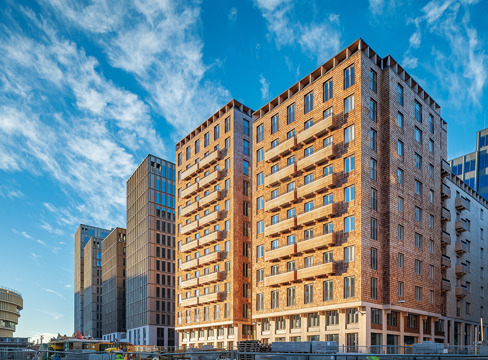
With the Cederhusen project, built 2020 – 2024 in Stockholm, Folkhem challenged this thesis. The site was cramped and offered no reasonable solution for weather protection. Folkhem therefore enlisted experts who established it would be possible to build without protection.
And so it was. The frame was erected from October to February, in rain, hail, snow and ice – and moisture was continuously measured.
“Timber regulates moisture by itself. It's an organic material. The important thing is not to seal it in, but ensure it can dry out to the right moisture content. When we'd erected the entire building and measured the moisture content, the timber had dried out. It went very, very quickly,” says Anna Ervast.
Cederhusen – a starting point
Cederhusen also became the starting point for something else. It was there that Folkhem seriously realised the value of connecting their projects with the research community – not for validation, but to learn faster and contribute to a knowledge base the entire sector can benefit from.
“It's not just about us learning. It's about connecting the experts and actors who drive development and linking them to our projects. Then we learn together, and the knowledge bank grows larger,” says Anna Ervast.
In practice, collaboration with the research community has taken several forms. For instance, Folkhem produced the world's first EPD for an entire building. They've collaborated with RISE on how climate calculations can be linked to BIM models at the concept stage, and participated in the Vinnova-funded project More Sustainable Urban Development Through Better Requirements in Land Allocation Processes. The company is currently participating in the EU project Wood Circles, which aims to accelerate the green transition in the construction sector by developing circular and sustainable solutions for timber construction.
“This type of applied research is valuable. We can use the projects we have, which makes the research relevant in a different way than if someone sits at a university thinking up something that might not be usable,” says Anna Ervast.
Folkhem hasn't just influenced and driven research. The company has also engaged politically, including by participating in the reference group for Boverket – the Swedish National Board of Housing, Building and Planning's development of the climate declaration law. According to Anna Ervast, participation was obvious since the company had already been working for a long time on climate calculations for its projects.
“We own the projects, and the digital tools were already there. What was missing was someone requesting the data, and verifying that what was requested was delivered,” she says.
Anna Ervast believes politics also needs to raise its awareness and knowledge level if the industry is to have a chance of reaching its climate targets. They are, after all, society's requirement setters and enablers of faster development on a larger scale, she reasons.
“For us, it's obvious and necessary to work transparently and credibly to help politics take its responsibility in the green transition of our industry, which accounts for a quarter of Sweden's emissions.”
Even though Folkhem has answered many of the questions that have emerged over the years, some remain unanswered. One of the most urgent is insurability. Over the past year, work on how timber buildings can be insured on reasonable terms has intensified.
“The answer isn't that we can't build timber buildings. It's a development that must happen. Insurance companies, emergency services, risk analysts and material suppliers must learn how these buildings actually behave, says Anna Ervast.
Text: Mattias Boström Photo: Sören Vilks