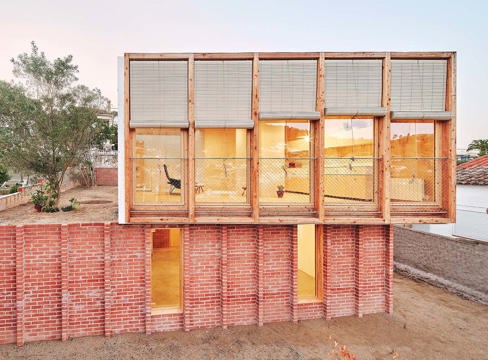


In many ways, this is an impossible site. Right at the mouth of the tunnel where the Gran Via arterial road has been decked over to make way for Barcelona's new focal point – the large park area Plaça de les Glòries Catalanes – stands Illa Glòries: a social housing block comprising four interconnected buildings with a total of 238 apartments.
An unusual competition and a cohesive neighborhood
The buildings were ready for occupation in spring 2025. Yet back in 2017, the City of Barcelona launched an international competition. The format was unusual: there would be four winners, one for each building, and one of the winners would determine the urban planning for the entire block. The other teams had proposed four small towers. But the winner, Cierto Estudio – which designed the overall concept and the westernmost of the four buildings, Illa Glòries A – wanted the buildings to be interconnected and to interact with the city and with each other, creatingopportunities for residents to meet.
"The collaboration with the other winners has meant that despite the buildings having completely different façade expressions and floor plans, they interact as a single unit – with shared entrances, stairwells, lifts, courtyards and access balconies running through the different buildings, as well as a public passage through the block,” says Ivet Gasol Escuer, one of six architects who together founded and run the collective architecture practice Cierto Estudio in Barcelona.
Wood as a supporting idea and climate strategy
Cierto Estudio's building is innovative and pioneering in many ways. Already at competition stage, the building was designed with a structural frame entirely in cross-laminated timber (CLT), and despite higher material costs, they were permitted to build in timber. Low climate impact, shorter construction time and reduced water consumption were arguments that supported this unusual material choice for Spain.
Geometry as a tool for space and flexibility
Social aspects guided the building's design. For Cierto Estudio, key concepts such as sustainability, anti-hierarchy, inclusivity, gender perspective, visibility, multiple connections, and ideas of playfulness with geometry and colour permeate both the overall plan and the individual apartments.
Ivet Gasol Escuer gives an example:
"We want to use every angle in the world, and the reason is neither trivial nor random. By exploring geometry, a multitude of possibilities emerge. A rectangular room allows for four entrances, while a hexagonal one enables six."
Social housing in Spain is typically very small. Most apartments in Illa Glòries A are four-room units of 52 – 55 m² (gross area 63 m²). With two bedrooms of 10 m² and a bathroom of less than 5 m², that leaves 25 – 30 m² for kitchen, living room and dining area.
But with the help of geometry, Cierto Estudio has made the apartments feel substantially larger. Thanks to rotating the kitchen, the centrally placed bathroom and the north facing bay window by 45 degrees, sightlines of more than 11 metres extend through the apartments.
The room orientation provides contact with the outside world in different directions, more sunlight and shade where you want it, greater privacy from neighbours, and better views towards the mountains.
"Rotating the rooms in this way also works extremely well with timber. The load-bearing structure becomes stronger than if the rooms had been rectangular,” says Ivet Gasol Escuer.
Also fundamental is the non-hierarchical and flexible floor plan. All rooms have equivalent dimensions, allowing residents to choose what function each room should have and adapt it to the family's changing structure and needs.
Kitchens, access balconies and the visibility of everyday life
Giving the kitchen a special status is another unusual solution in Spain. Despite its central function in the home, Spanish apartment kitchens are usually placed inside the dwelling without windows.
"We want to change that and have coined the term 'kitchroom'. In Illa Glòries, the kitchens are consequently positioned against the external wall and the access balconies. They have windows in two directions, providing views and access to natural light and ventilation. The kitchens are also positioned so that sightlines into the apartment are as long as possible,” says Ivet Gasol Escuer.
The placement facing the wide south-facing access balconies – which also function as outdoor spaces – makes domestic work visible and creates a transition between the private sphere and the shared areas. The access balconies also set the apartments back within the building, protecting them from direct sun in summer while admitting light in winter when the sun is lower.
"The access balconies also serve an important social function. When neighbours see each other and have more contact, it increases safety for residents. This is not least important from a gender perspective,” says Ivet Gasol Escuer.
Technical fact
The strucutre is built in cross-laminated timber and meets the EU standard for Nearly Zero Energy Buildings (NZEB).
Cross-ventilation, solar shading with awnings and external louvres in breathable fabric, protection from the southern aspect provided by the access balconies, and double-glazed windows with low-emissivity coating contribute passively to the building's thermal comfort. This is supplemented by a mechanical ventilation system and an air-source heating system. Over 60 per cent of the plot is designated for planting to counteract the urban heat island effect.
Particular attention was paid to acoustics and fire safety. To increase acoustic insulation and reduce vibration between dwellings, the CLT floor slab is supplemented with a 2 cm thick layer of stone wool, an impact-resistant board and a layer of morite on top. In addition, fibreglass panels were placed directly on the floor slab element and on the suspended ceiling panels, fixed with anchors and vibration dampers.
The walls are fire-protected internally with laminated plasterboard and externally with cement boards. All internal walls are sound-insulated with glass wool and the façade with 10 cm stone wool boards. On façades with the highest acoustic requirements, a self-adhesive synthetic sound insulation membrane based on high-density polymer, called Tecsound from manufacturer Soprema, was also applied directly to the timber panel to reduce noise.
Floor plans
Flexible floor plans for the apartments make them adaptable and ensure that the dwellings can evolve in step with residents' changing needs. The apartments are also designed to de-hierarchise the home by not having any predefined spaces. Instead, rooms of similar size and character allow residents to allocate space freely according to their needs, with the intention of promoting equality in everyday life.
Access balconies
Access balconies connect the different buildings. This means residents can move through and between them and use stairwells and lifts in other buildings – which also has the advantage that Illa Glòries A has only one stairwell.
Text: Carl-Johan Liljegren Images: Jose Hevia and Marta Vidal