

Just a few hundred metres from HPP Architekten's head office in Düsseldorf's old harbour district stands The Cradle – a building where almost every component can be reused. It is Germany's first office building developed entirely according to the Cradle to Cradle principle, an international standard for circular and sustainable design. The principle is based on keeping everything in closed loops, and on every solution creating added value; it underpinned the sustainability strategy developed together with the client, The Cradle GmbH & Co. KG.
A building with a strong identity and a focus on sustainability
“Düsseldorf's harbour district is known for its iconic and diverse architecture. In this vibrant and heterogeneous environment it was important for us to create a building with a clear identity – one that not only stands out visually, but also responds to today's societal challenges. The Cradle embodies this ambition: it is bold, forward-looking and rooted in sustainability,” says Antonino Vultaggio, senior partner at HPP Architekten.
The façade's rhombic structure is more than a decorative skin. Engineering firm Knippershelbig, specialists in structural and façade engineering, developed a design where V- shaped larch columns connect to edge beams via beech connectors, allowing easy disassembly.
“We chose high-grade larch because it is naturally weather-resistant, and beech for its hardness and dimensional stability. Spruce or pine would probably not have worked in these components,” says Roman Schieber, CEO of Knippershelbig.
According to the Cradle to Cradle principle, every component has been documented in a circular passport describing the materials' contents and origins. The documentation tool is also used to calculate the building's circularity.
Halved carbon footprint and high recycling rate
Compared to a conventional building, The Cradle has reduced its carbon footprint by 50%, and over 90% of the materials can be recycled. The building's hybrid structure comprises concrete in the basement and core, along with timber in the five upper storeys. Spruce was used in the internal structure, while larch and beech were used in the load-bearing façade structure. In total, 2,150 cubic metres of timber, mainly from forests in Germany and the rest of Europe, were used in the structural frame.
“The large volume of timber helped reduce the building's carbon footprint,” says Roman Schieber.
Natural materials for health and wellbeing
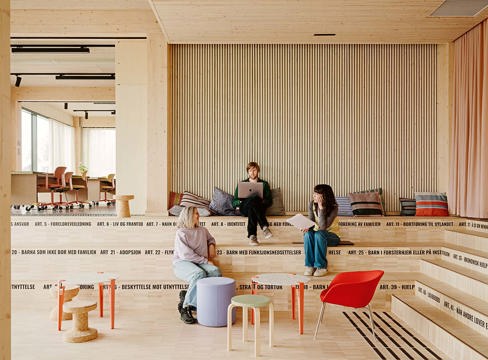
Inside, the building is characterised by exposed timber, clay plaster and green walls that create a warm and natural working environment.
“With The Cradle we wanted to create a work environment that supports health and wellbeing. By combining natural timber, living walls and clay surfaces we achieve an atmosphere and air quality that makes people feel alert, focused and inspired every day,” says Antonino Vultaggio.
The columns carry the structure
The V-shaped larch columns function as both solar shading and load-bearing structure. The depth of the façade's recesses varies by orientation – to the south and west they form loggias that open the building towards the water. The columns transfer vertical and horizontal loads and interact with the building's concrete core to provide stability. Columns and beams are joined together with connectors in laminated beech veneer.
"Many simulations were required to optimise each node," explains Roman Schieber.
The structure is designed so that components can easily be dismantled and reused in the future. Therefore, minimal screws and adhesive have been used.
Text: Gustav Schön Images: Achim Birnbaum, Chris Rausch, Ralph Richter, Knippershelbig Drawings: HPP Architekten Renders: Knippershelbig